The points meta reality check
The current points meta airdrop analysis reveals a system that operates in the shadows of traditional crypto incentives. Unlike legacy airdrops, where token distribution is verifiably coded into smart contracts based on predefined on-chain criteria, points are a promise, not a property [1]. This distinction creates a high-stakes environment where participants gamble time and capital on rewards that may never materialize.
In a traditional airdrop, the rules are fixed. If you meet the criteria, you receive the token. Points farming removes this guarantee. There is no hardcoded value, no fixed timeframe, and no assurance that the protocol will ever issue a token. Changes to the points system can be made arbitrarily by the protocol team, leaving users with no recourse if the value is diluted or the program is canceled [2].
This lack of transparency transforms participation into a speculative exercise rather than a reward for utility. Users are essentially betting on the protocol's goodwill and future funding, rather than claiming a verifiable asset. The risk is not just low returns; it is the total loss of the effort invested in farming these points.
How the Points Meta Airdrop System Works
The MetaMask points system, recently detailed in their official GitHub repository, shifts the focus from passive holding to active transactional volume. Unlike traditional airdrops that reward early adoption or simple wallet interactions, this infrastructure is designed to measure genuine usage of the wallet's embedded financial tools.
Points are primarily awarded based on spot and futures trading volume processed through MetaMask Swap and the Web3 On-ramp feature. The more you trade, the more points you accumulate. This structure effectively turns the wallet into a performance metric for ecosystem engagement rather than just a storage device.
The system also accounts for historical behavior. Past activity reward points are factored into the total score, meaning early adopters who have consistently used the wallet’s features over time may hold an advantage. However, the primary driver remains current volume, creating a dynamic where continuous interaction is necessary to maintain a competitive standing.
This approach aligns with broader industry trends toward sustainable incentive models. By tying rewards to measurable economic activity, MetaMask aims to ensure that any potential token distribution reflects users who are actively contributing to the network's liquidity and utility, rather than those simply farming empty interactions.
Market Context and Risk
While the points system provides a clear pathway for accumulation, it operates within a volatile market environment. The value of any future airdrop is intrinsically linked to the performance of the underlying asset and the broader crypto market conditions. Traders should monitor market trends closely, as high volatility can impact the real-world value of trading volume.
The reliance on trading volume also introduces specific risks. Users engaging in high-frequency trading solely to accumulate points may find that transaction costs and slippage erode any potential gains. It is essential to distinguish between strategic usage and speculative farming, ensuring that your activity aligns with your broader investment goals rather than just the airdrop mechanics.
Comparing points farms to token airdrops
The core difference between these two systems comes down to verifiability. Traditional token airdrops are defined by smart contracts that automatically distribute tokens based on predefined on-chain criteria. This code-based distribution offers a level of transparency that crypto points systems simply lack. Points are generally an internal metric with no hardcoded distribution rules, making the final reward a promise rather than a proven entitlement.
| Feature | Points Systems | Token Airdrops |
|---|---|---|
| Verifiability | Low; internal database records | High; on-chain smart contracts |
| Reward Certainty | Low; subject to protocol changes | High; predefined eligibility criteria |
| Timeframe | Open-ended; no fixed end date | Fixed; snapshot dates and deadlines |
| Gas Costs | Often zero for participation | High; claiming often requires gas |
The uncertainty of points farming is a significant risk factor. Because the distribution is not coded into a public contract, protocols can change the rules, adjust multipliers, or even cancel the airdrop entirely. In contrast, once a token airdrop is announced, the eligibility is mathematically fixed. You can verify your status on a block explorer, providing a clear path to your potential rewards without relying on the platform's discretion.
While points farming is often cheaper to participate in—sometimes requiring zero gas fees—the potential upside is less certain. Token airdrops typically require active engagement and transaction fees, but the resulting token allocation is a tangible, verifiable asset. For a Points Meta Airdrop analysis, understanding this trade-off between low-cost uncertainty and high-cost certainty is essential for managing your risk exposure.
Market performance of recent airdrops
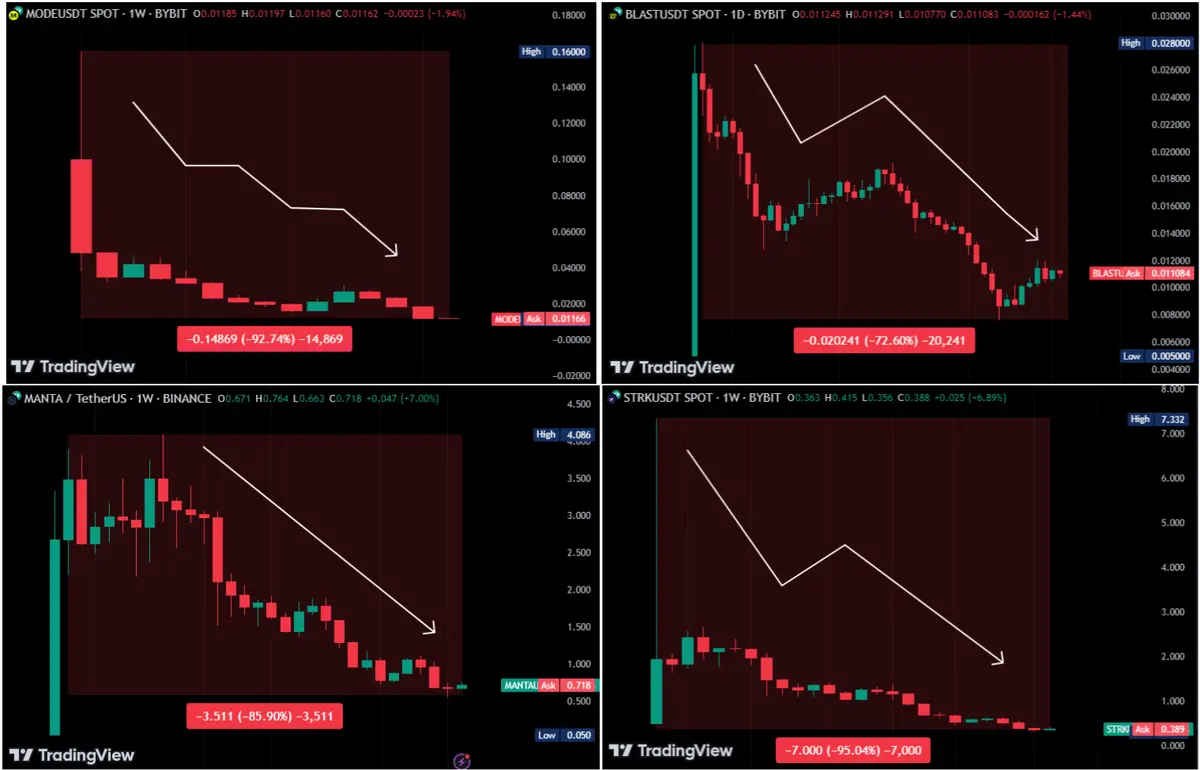
The history of crypto airdrops is littered with initial spikes followed by steep declines, a pattern that defines the current "Points Meta." Unlike the early days of Ethereum where participation drove long-term value, recent token distributions have often acted as immediate liquidity events for farmers rather than community building exercises. Gate.com’s analysis of the sector since 2023 highlights a significant "lull in performance," noting that most airdrop tokens have underperformed relative to broader market trends or their initial hype.
This dynamic creates a structural headwind for Points Meta airdrops. As noted by Footprint Analytics, protocols that distribute tokens to high-volume farmers often face immediate selling pressure. When the primary incentive is extraction rather than engagement, recipients tend to dump tokens immediately upon claim, making it difficult for the token price to sustain upward momentum. This behavior transforms the airdrop from a reward mechanism into a short-term liquidity drain.
To understand the scale of this risk, one must look at live market data for recently distributed tokens. The following widget shows the real-time price action of a prominent airdropped asset, illustrating the volatility and downward pressure these tokens often face post-distribution.
The data suggests that without a strong utility backbone, points-based systems risk becoming obituaries for token value rather than launchpads for adoption. Investors should approach these opportunities with caution, recognizing that the "lull" is not a temporary dip but a reflection of changed market incentives.
Strategies to mitigate points farming risk
Points farming often feels like a race, but without a strategy, it’s a fast track to draining your wallet. The goal isn’t just to accumulate points; it’s to do so while keeping your capital exposure low and your gas costs manageable. Treat your participation like a portfolio trade: diversify your efforts and cut your losses when the math stops making sense.
Don’t put all your activity on one network. Spreading your interactions across different chains reduces the risk of a single protocol failure or a sudden gas spike wiping out your gains. This approach mirrors how you’d balance a traditional investment portfolio to protect against market volatility.
Gas fees are the silent killer of airdrop profits. Before you execute a transaction, calculate the cost of the gas against the potential point value. If the fee exceeds the estimated reward, skip it. Use transaction estimators to ensure you aren’t paying a premium for a low-value interaction.
Interacting with unverified or new smart contracts is a major hazard. Always check if the contract address is verified on block explorers like Etherscan and look for audit reports from reputable firms. If a protocol lacks transparency or has no track record, the points aren’t worth the risk of a drain.

Keep a simple log of your interactions and the points earned. Regularly review your cost basis against current market conditions. If a protocol’s tokenomics shift or the points become harder to earn, be ready to exit early. Locking into a losing position is the fastest way to turn a potential gain into a permanent loss.
The points meta is volatile. By treating each interaction as a calculated risk rather than a chore, you protect your capital and ensure that your time translates into actual value, not just network congestion.
Common questions about points meta airdrops
Understanding the mechanics behind points-based systems is essential before committing time or capital. These programs often function as loyalty metrics rather than direct equity claims, meaning your engagement level dictates your potential payout.
What do points mean in the crypto airdrop arena?
Points generally track your activity, such as trading volume or liquidity provision, to determine your rank on a leaderboard. For example, Crypto.com’s Airdrop Arena allocates points based on CRO token balances, with higher ranks unlocking greater rewards from monthly prize pools. These points are not tokens themselves but serve as the eligibility key for future distributions.
What is the average hype airdrop?
Recent data from Hyperliquid illustrates the variance in distribution sizes. According to ASXN data, the project airdropped 274 million HYPE tokens to roughly 94,000 addresses. This resulted in an average of 2,915.66 HYPE per wallet, though the median was significantly lower at 64.53 HYPE. This disparity highlights that "average" figures can be skewed by a small number of large holders.
How do points meta airdrops compare to traditional token sales?
Unlike traditional token sales where you purchase equity upfront, points airdrops require upfront work or capital deployment with no guaranteed return. The risk is higher because the token may never launch, or it may launch at a value lower than the cost of your participation. Always verify the project’s official documentation to understand if points are transferable or if they expire.
No comments yet. Be the first to share your thoughts!