Is the MetaMask airdrop confirmed
The $MASK token launch is official. Consensys CEO Joseph Lubin has confirmed that MetaMask will introduce its own native token, transforming the wallet from a utility into a stakeable asset. The question for users is no longer if the token exists, but how the points accumulated through the current rewards program will convert into holdings.
MetaMask launched its rewards program in October 2024, creating the "Points Meta" infrastructure that tracks user activity. By opting in, users earn points for swapping tokens, trading perps, and bridging assets. These points are the primary mechanism for qualifying for the airdrop, serving as a proxy for loyalty and network contribution.
While a specific date for the token generation event (TGE) has not been set, the infrastructure is live. Over 30 million monthly active users are currently generating points, positioning MetaMask as the most anticipated free crypto airdrop of 2026. The program is designed to capture on-chain behavior, meaning your activity within the wallet is the only metric that matters for eligibility.
Market analysts expect the conversion rate from points to tokens to depend on the total supply distribution and the duration of the rewards period. Until Consensys releases the final tokenomics, the focus remains on accumulating points through active use of the wallet's built-in swap and bridge features.
How the Points Meta Airdrop Infrastructure Works
The MetaMask Rewards program functions as a data collection and attribution layer rather than a traditional staking protocol. When you opt in, the system begins tracking specific on-chain activities to calculate your eligibility for the upcoming $MASK token allocation. This mechanism is designed to reward active users who bring liquidity and volume to the MetaMask ecosystem, particularly through its integrated swap and perpetual trading features.
Tracking On-Chain Activity
Points are generated primarily through two actions: swapping tokens and trading perps within the MetaMask wallet interface. Unlike many airdrops that rely on retroactive snapshotting of historical data, MetaMask’s infrastructure is forward-looking. You must actively engage with the platform to accumulate points. The system logs these transactions on the Linea zkEVM L2, ensuring that activity is verifiable and transparent.
The Role of Linea and Consensys
MetaMask is built on Consensys infrastructure, and its rewards program is deeply integrated with Linea, its zero-knowledge Ethereum Virtual Machine (zkEVM) layer-2 network. This connection is strategic. By routing activity through Linea, MetaMask reduces gas costs for users while gathering precise data on user behavior. The $30M+ in LINEA tokens already distributed through this program serves as a proof-of-concept for the broader tokenomics model expected with the $MASK launch.
From Points to Token Allocation
The translation of points into actual tokens is not yet fully detailed in the official documentation, but the mechanism is expected to follow a tiered distribution model. Points act as a proxy for contribution. High-volume traders and consistent swappers will likely receive higher allocation weights. This structure incentivizes long-term engagement over one-time farming, aligning user behavior with the platform’s growth metrics. Keep an eye on the official MetaMask Rewards dashboard for real-time point tracking and eligibility updates.
Compare points farming strategies
Earning points for the MetaMask ($MASK) airdrop isn't a one-size-fits-all process. The program distinguishes between different types of on-chain activity, assigning varying weights to swaps, perpetual trading, and staking. Understanding these mechanics helps you allocate capital where it generates the most efficient yield.
MetaMask Rewards tracks activity through specific tracks. Swapping tokens through the built-in aggregator is the baseline activity, while trading perps on integrated DEXs often carries higher multipliers. Bridging assets between networks is also tracked, but typically at a lower efficiency than direct trading activity.
The table below breaks down the core differences between the primary farming methods. Use this to decide which strategy aligns with your existing portfolio habits.
| Activity | Effort Level | Capital Required | Point Multiplier |
|---|---|---|---|
| Token Swaps | Low | Variable | Base |
| Perpetual Trading | Medium | High | High |
| Staking (LINEA) | Low | High | Medium |
| Cross-Chain Bridging | Medium | Variable | Low |
Swapping is the most accessible entry point. You earn points for every swap executed through the MetaMask interface. This requires minimal setup and works well for small, frequent transactions. However, the base multiplier means you need significant volume to compete with active traders.
Perpetual trading offers the highest point density. By trading perps through integrated partners like dYdX or GMX, you earn points on both open interest and volume. This method requires more capital and active management, but the return on effort is significantly higher. It is ideal for users already engaged in derivatives markets.
Staking and bridging serve as passive or supplementary strategies. Staking LINEA tokens provides steady points with low effort, though the multiplier lags behind active trading. Bridging is useful for moving capital between chains but yields fewer points relative to the gas and time cost. Combine these with active swapping to maximize your overall score without overexposing your capital.
Market analysis and price impact
The potential launch of the $MASK token represents a structural shift in the decentralized identity space, but it also introduces immediate liquidity challenges. With over 30 million monthly active users, MetaMask is no longer just a wallet; it is a gateway. The market impact will depend less on hype and more on how the initial token distribution interacts with existing liquidity pools.
Liquidity and Supply Shock
Airdrops of this magnitude create a classic supply shock. If a significant portion of the airdropped tokens is sold immediately upon listing, the price could experience high volatility before stabilizing. Unlike smaller projects, MetaMask cannot rely on speculative retail interest alone to sustain price action. The infrastructure must support high-frequency trading from day one to prevent slippage from eroding user value.
Investors should monitor the vesting schedules for early contributors and team allocations. A concentrated sell pressure from insiders within the first 30 days would likely suppress the price ceiling, regardless of the project's long-term utility. The difference between a successful launch and a "pump and dump" lies entirely in this initial liquidity depth.
Competitor Landscape
The decentralized identity market is crowded, but MetaMask's distribution network is unmatched. Competitors like Polygon ID or Worldcoin offer similar verification layers, but they lack the seamless integration that MetaMask provides to its massive user base. This network effect is the primary moat.
| Feature | MetaMask ($MASK) | Polygon ID | Worldcoin |
|---|---|---|---|
| User Base | 30M+ MAU | 10M+ | 20M+ verified |
| Integration | Native Wallet | SDK/API | Biometric App |
| Identity Type | On-chain Reputation | Zero-Knowledge Proof | Proof of Personhood |
| Launch Status | Pre-market | Live | Live |
Source: CoinGecko and official project documentation.
Technical Outlook
While pre-market sentiment is difficult to gauge, the technical setup for $MASK will be critical. Traders should watch for volume spikes on major exchanges during the initial listing window. A sustained move above the initial opening price within the first hour often signals strong institutional or whale accumulation, rather than just retail flipping.
Final checklist for eligibility
To qualify for the Points Meta Airdrop 2026, you must move beyond passive holding and engage with the MetaMask Rewards infrastructure. Eligibility is not automatic; it requires deliberate action to link your wallet to the points system and generate verifiable on-chain activity.
Navigate to the Rewards section in your MetaMask wallet and explicitly opt-in. Without this active consent, your trading activity remains invisible to the points ledger. This step is mandatory to trigger any point accumulation.
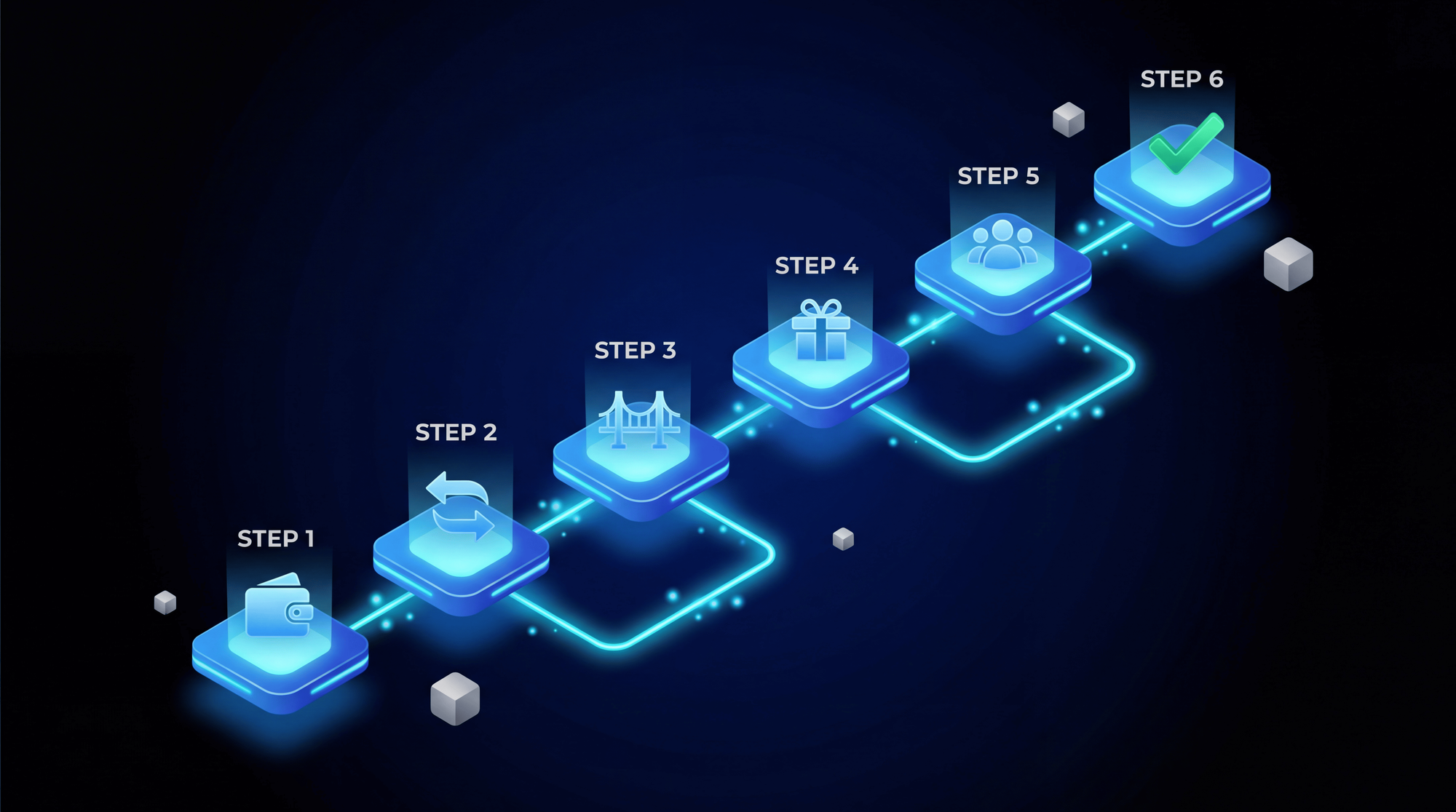
Points are generated through specific on-chain actions. Focus on trading perpetuals or swapping tokens directly through the MetaMask interface. Passive holding of assets does not contribute to your eligibility score; volume and interaction frequency are the primary drivers.
Consistency matters. Ensure your wallet remains active throughout the eligibility window. Sporadic usage may result in a lower tier allocation. Monitor your points dashboard regularly to confirm that transactions are being recorded correctly by the infrastructure.
Common questions about MetaMask points
The MetaMask points system launched in October 2024, creating a clear path toward the $MASK token. Consensys CEO Joseph Lubin has officially confirmed that a token is coming, shifting the conversation from speculation to mechanics. With over 30 million monthly active users, the infrastructure is already in place to support a major distribution event in 2026.
Is the MetaMask airdrop confirmed?
Yes. The airdrop is confirmed through official channels, but the exact distribution model remains in flux. Points are currently awarded for on-chain activity, such as swapping tokens or bridging assets, rather than simple holding. The $MASK token will likely be distributed based on accumulated points, meaning early and consistent usage is the primary driver for eligibility.
Do I need to hold XRP or other assets to qualify?
No. The XRP airdrop is a separate initiative by Ripple and is unrelated to MetaMask. MetaMask points are earned through activity within the MetaMask wallet ecosystem, not by holding specific external tokens. You do not need to buy or hold XRP, Bitcoin, or Ethereum to participate, though using MetaMask to swap these assets will generate points.
When will the $MASK token launch?
There is no fixed date for the token launch. The project operates on a "points-to-token" model, where the conversion ratio and snapshot date will be announced closer to the event. Market analysis suggests a 2026 timeline, but users should treat this as an estimate. The infrastructure is designed to allow for a gradual rollout rather than a single instant distribution.
No comments yet. Be the first to share your thoughts!