The Current Airdrop Landscape
The era of passive airdrop farming is effectively over. If you are still treating crypto points like lottery tickets, you are likely setting yourself up for significant losses. The market has shifted from a period of generous, low-effort distribution to a harsh environment where most new tokens fail to hold any value.
Data from 2024 paints a stark picture of this transition. According to analysis by ChainCatcher, approximately 88% of airdrop tokens decreased in price within just 15 days of their launch. This isn't a minor dip; it is a systemic collapse of speculative value. Most of these tokens plummeted shortly after listing, leaving early participants with assets that quickly became illiquid or worthless.
This trend indicates that the "meta" of airdrops has fundamentally changed. Projects are no longer distributing tokens simply to attract users; they are using points systems to filter for genuine utility and long-term engagement. The days of claiming tokens without interacting with the core product are gone. For 2026, success will depend on identifying projects with real infrastructure and transparent governance, rather than chasing the next hype cycle.
To understand the volatility you are up against, look at the broader market context. The following chart shows recent performance trends that highlight the risks involved in speculative crypto assets.
The lesson is clear: treat every airdrop as a high-risk venture. Do not assume that points equal profit. Instead, focus on projects that demonstrate sustainable usage and clear utility, as these are the only ones likely to survive the inevitable post-launch sell-off.
Decoding the points meta
Points systems in crypto are not just loyalty programs; they are a proxy for future token value. By tracking user activity—such as trading volume, bridging frequency, or liquidity provision—projects create a measurable score that often converts into governance rights or equity upon token launch. This mechanism allows infrastructure providers like MetaMask to build community engagement without immediate financial liability.
The strategy hinges on understanding how different platforms weight these activities. For instance, MetaMask’s points model, recently detailed in their GitHub documentation, rewards users based on spot and futures trading volume alongside past activity metrics. This creates a feedback loop where active usage directly correlates with potential airdrop eligibility, turning everyday transactions into strategic positioning.
To evaluate the potential of these systems, it is essential to compare the mechanisms across major infrastructure players. The table below contrasts how different platforms accrue and value points, highlighting the diversity in strategy and potential upside.
While points offer a clear strategy for maximizing potential returns, they are not guaranteed value. The conversion rate from points to tokens varies wildly depending on the project’s tokenomics and market conditions at launch. Investors should treat points as an option on future utility rather than a fixed asset.
Infrastructure metrics to track
Points systems are often a prelude to a token launch, but points alone don't guarantee value. You need to look at the underlying on-chain activity to separate projects with real traction from those just burning marketing budget. Tracking infrastructure metrics like total value locked (TVL), active addresses, and trading volume gives you a clearer picture of a project's health and its potential airdrop value.
Total value locked (TVL) is the most straightforward health indicator. It measures the total amount of assets deposited into a protocol's smart contracts. A rising TVL suggests that users trust the platform with their capital, which is a strong signal of legitimacy. However, TVL can be manipulated through incentives. Look for organic growth rather than spikes driven solely by yield farming rewards. If TVL is high but user engagement is low, the project may be relying on "farmers" rather than genuine users.
Active addresses and trading volume provide context for that capital. High volume with low active addresses can indicate bot activity or wash trading, which inflates metrics without real user participation. Conversely, a steady increase in unique active addresses suggests a growing, engaged community. These metrics help you identify whether the points you're earning are backed by real economic activity or just artificial inflation.
To contextualize these metrics, it helps to look at how infrastructure tokens perform relative to broader market trends. A project with strong fundamentals might still struggle if the overall market is bearish, but it should hold up better than weaker projects.

When evaluating these metrics, prioritize official sources and primary data over third-party summaries. Tools like Footprint Analytics or similar on-chain explorers can help you verify these numbers directly. By focusing on these concrete indicators, you can better assess the risk and potential reward of participating in a points-based airdrop.
Strategic farming in 2026
Points systems have replaced direct token drops as the primary mechanism for crypto airdrops. This shift demands a more disciplined approach to resource allocation. You are no longer farming for free tokens; you are investing time and capital into a probabilistic outcome. Success in 2026 depends on treating points like a portfolio rather than a lottery ticket.
The following steps outline how to evaluate and engage with potential airdrop opportunities without overexposing your capital.
A good airdrop is more than free tokens; it is a reward from a project with real utility, transparency, and long-term potential. Avoid protocols that exist solely to harvest attention. Instead, focus on platforms with active development, clear governance, and genuine user demand. This distinction separates sustainable farming from speculative noise.
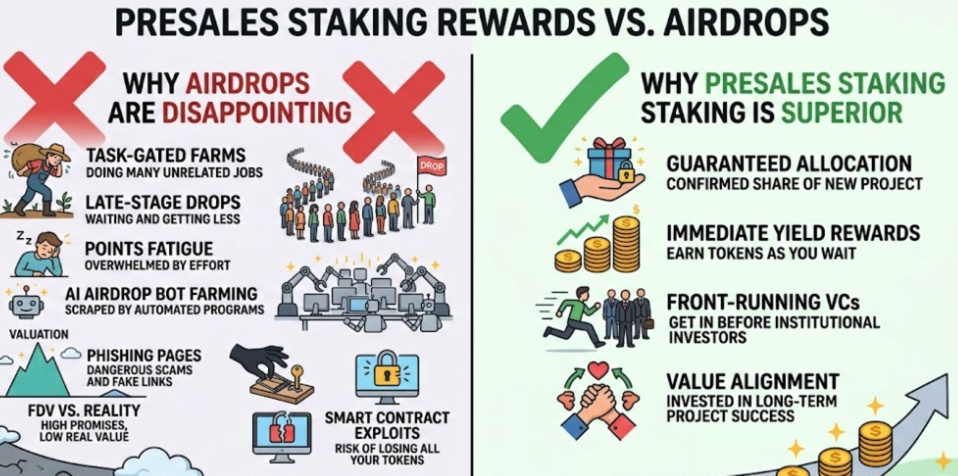
Calculate the total cost of farming, including gas fees, capital lock-up, and opportunity cost. If the required capital exceeds your risk tolerance, the potential reward may not justify the exposure. Prioritize protocols that allow meaningful participation with minimal upfront investment or offer flexible staking options.
Spread your efforts across multiple protocols to mitigate the risk of any single project failing or changing its reward structure. Look for projects with strong community support and clear points mechanisms. Diversification ensures that if one airdrop underperforms, others may compensate for the loss.
Use real-time feedback to track your progress. Platforms like Airdrop Arena rank users based on points, providing a clear view of where you stand. Regularly check leaderboards and protocol updates to adjust your strategy. Staying informed helps you capitalize on bonus periods or new earning opportunities.
Set clear exit criteria for each airdrop. If a protocol’s points system becomes opaque or the potential reward diminishes, move your resources elsewhere. Do not let sunk cost fallacy keep you engaged in low-value farming. Discipline is key to long-term success in the airdrop arena.
The crypto landscape is evolving rapidly. By focusing on utility, cost efficiency, and disciplined execution, you can approach the points meta with confidence. Remember, the goal is not to chase every drop, but to build a sustainable strategy that maximizes your returns while minimizing risk.
Common airdrop: what to check next
Navigating crypto incentives requires separating marketing from mechanics. Here are the most frequent questions about spotting value and understanding points systems.
No comments yet. Be the first to share your thoughts!